
Garden Fountain Pumps: Flow Rates, Running Costs and Keeping One Clean
30 September 2026 · Geoffs Garden Ornaments · Care & Maintenance · fountain pumps, fountain maintenance, garden fountain
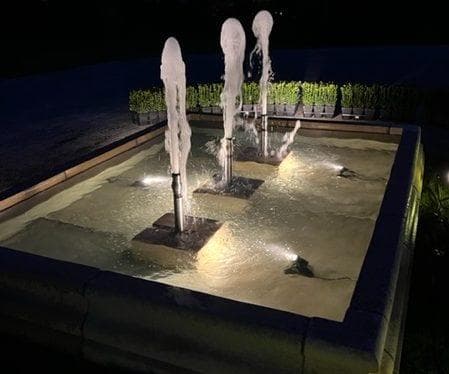
The pump is the only moving part in a garden fountain, the cheapest component in it, and the one people worry about most. It needn't be a worry. Nearly everything that goes wrong with a fountain pump comes down to one of three things, and all three are preventable.
Here's what the numbers on the box mean, what it costs to run, and how to keep one going for years.
What the pump actually does
A fountain pump is submersible: it sits in the water at the bottom of the reservoir, draws water in through a filtered inlet, and pushes it up a pipe to the top of the piece, where gravity takes over. The same water goes round and round. You are not feeding it from the mains, and it doesn't drain away — you only top up what evaporates or blows off in the wind.
That matters for two reasons. It's why a fountain uses far less water than people expect, and it's why keeping the water reasonably clean is worth the effort: whatever is in it passes through the pump several hundred times a day.
Flow rate: what LPH means
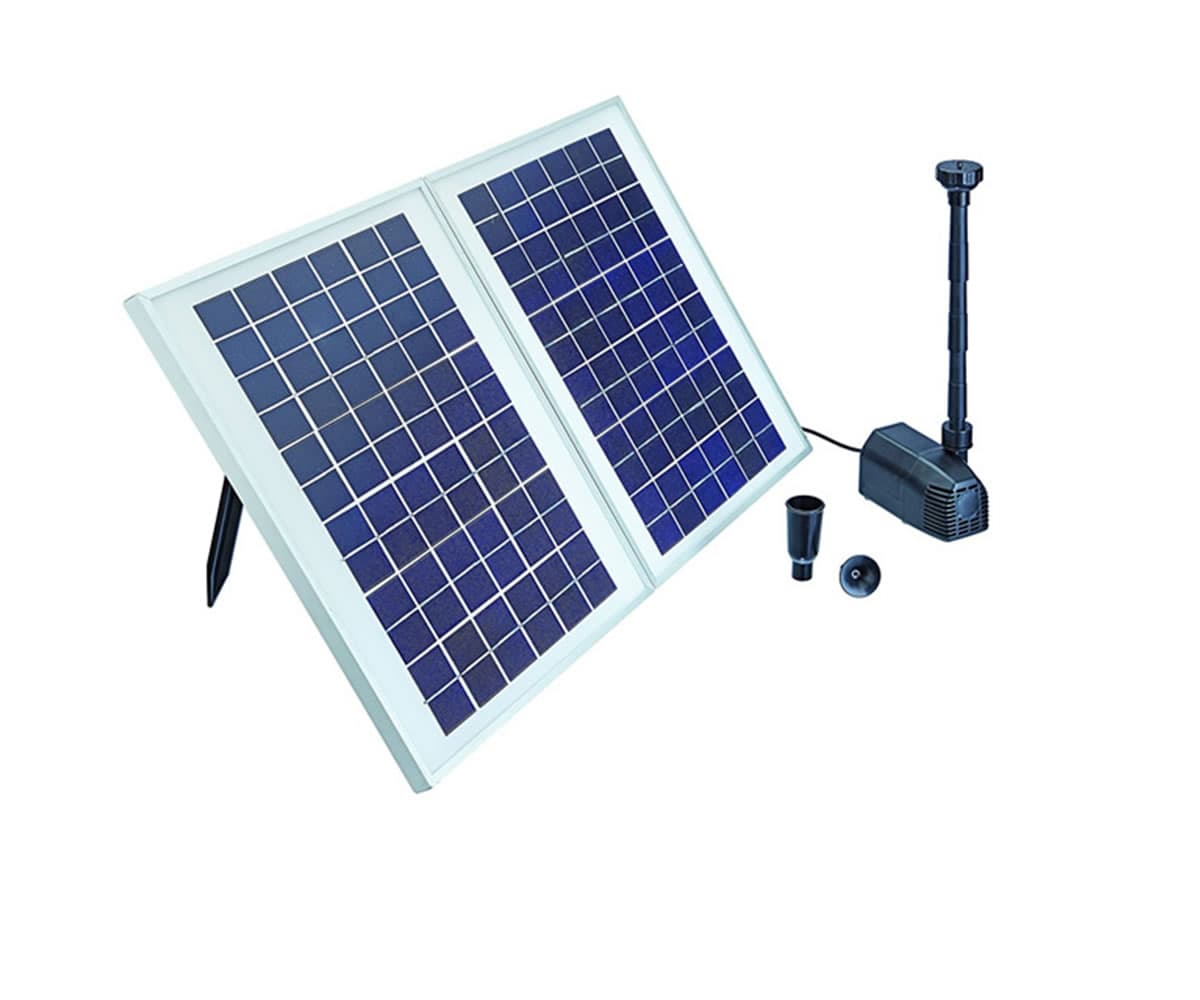
Pumps are rated in LPH — litres per hour. Our solar pumps, for instance, come at 250, 600 and 1600 LPH.
Two things to understand about that figure:
- It's a maximum, measured at zero height. Every pump moves less water the higher it has to lift it. The height a pump can manage is its "head", and at its maximum head the flow is effectively nil. A pump lifting water a metre up a tiered fountain is delivering well under its headline rating.
- Bigger is not better. Over-pump a small bowl fountain and you don't get a more impressive display, you get water thrown clear of the bowl, a reservoir that empties into the border, and a noise like a tap left running.
As a rough guide: a small self-contained patio feature wants something in the 250–600 LPH range, a tiered fountain with a pool surround wants more, and a tall jet or a wide multi-tier piece wants considerably more again. We supply every fountain with a pump matched to it, so unless you're replacing one on an older feature, this is a decision that's already been made for you.
If you're buying a replacement, the number to match is the one on the old pump, not the biggest one on the shelf.
What it costs to run
Less than most people assume. Fountain pumps are small motors, typically drawing somewhere between about 20 and 60 watts depending on the size of the feature.
The sum is straightforward, and worth doing with your own electricity rate rather than a figure from an article:
watts ÷ 1,000 × hours run per day × your unit rate = cost per day
As an illustration, a 30W pump run eight hours a day uses 0.24 kWh — about a quarter of a unit of electricity. Multiply that by whatever you currently pay per kWh and you have your daily cost; multiply by thirty for the month. For most people, running a modest fountain through the summer evenings costs less than a cup of coffee a week. Check it against your own tariff rather than taking our word for it.
Two easy savings. Put it on a timer so it runs when you're in the garden rather than at three in the morning. And consider a solar pump for a smaller feature, which costs nothing to run at all.
Why pumps stop — and it's usually not the pump
When a fountain slows to a dribble or stops, the cause is almost always one of these three, in this order of likelihood:
- A blocked inlet. Leaves, blossom, algae, grit and, surprisingly often, a snail. The pump is fine; it simply can't draw water.
- The water level has dropped below the pump. A submersible pump must stay submerged. Run one dry and it will overheat, which is the main way people actually destroy a pump.
- A jammed or furred impeller. The small spinning rotor inside. Limescale in hard-water areas, or grit, stops it turning.
Check those three before you conclude anything has failed. Genuine pump failure is the rare case, not the first assumption.
Cleaning a pump
Ten minutes, twice a season, and once more before it goes away for the winter.
- Switch off at the mains first, every time.
- Lift the pump out and rinse the outer housing and filter cage under a tap.
- Open the front cover — most twist or unclip — and slide out the impeller.
- Clean the impeller and its chamber with an old toothbrush. In a hard-water area, an hour in a weak white-vinegar solution shifts limescale that won't brush off.
- Reassemble, refit, and check the flow before you walk away.
Never use detergent — residue gets into the water and it's the water your birds are drinking from. If a pump is badly scaled or has been left a few seasons, our pump cleaning service is a good deal cheaper than a new one.
Keeping the water clean in the first place
A pump in clean water barely needs attention. Keep leaves out, site the feature away from overhanging trees where you can, and scrub any algae off the stone with a stiff brush and plain water before it gets into the system.
Don't put chemicals in a fountain that birds and insects use. Topping it up with fresh water regularly does more than any additive.
Over the winter
Take the pump out, clean it, and store it somewhere frost free — a pump left in an empty bowl can be split by ice. There's a full autumn checklist in our guide to winter care for stone fountains.
See what we supply on our pond liners, pumps and lights page, or browse fountain upgrades and extras. Prices include delivery to most mainland UK postcodes.
The product in this post
Related posts

30 September 2026
Winter Care for Stone Fountains: Frost, Pumps and the Autumn Jobs Worth Doing
Our cast stone is frost proof and can stay outside all year. Standing water is what does the damage. Here's what to do before the first hard frost, how to look after the pump, and why draining matters more than covering up.
30 September 2026
What Is a Sump Fountain? How Sump Water Features Work
A sump fountain hides its reservoir below ground, so the sculpture appears to rise straight out of the paving with no pool around it. How they work, what installing one involves, and the six in our range.
30 September 2026
Wall Fountains for Courtyards and Small Gardens
When there's no floor space to give up, the water goes on the wall. What a wall fountain needs behind it, how to deal with sound in an enclosed courtyard, and the range from a small Tapas mask to a six-foot Niagara.